Blog Feed

The two Bodies

The last post is about the sport which is closest to my heart – horse riding. I have been practicing it since I was 10 years old and I have my own, great horse named Pedro. This module has inspired me to reflect on what happens with my body when I am riding, particularly on the union of bodies, gender and sensory experience in the equestrian sport. 

Although I cannot express it, there is an unusual feeling of oneness with my horse, which only riders themselves can fully understand, I think. Horse riding seems very simple, but in fact, it is a very difficult task. Not only does it involve most of the human muscles and requires a very precise position of the body, but also it requires this body to correlate with a non-human partner. The union of those two bodies creates a new world or way of being (Merleau-Ponty 1962), where knowledge is transmitted through body techniques and cues instead of verbalisation. The anthropological study of equestrianism can thus prove the argument that the body is more than just an outer shell; it is a relational embodiment of knowledge that acts as a language, or means of communication (Farnell 1999), which can even cross the boundaries between species in this case.  

When it comes to professional horse riding, the theme of gender emerges again. Equestrianism is the only olympic sport where men and women are not separated in competition. Although it is still considered a rather feminine sport and there are more women participating in amateur-level competitions, it is actually the male riders who often win the most important ones. The gendered body somehow becomes neutralised by the presence of the horse. Unlike gender-unique sports teams (basketball, volleyball, football etc.), in horse riding, the team is composed of inter-species team members and gender becomes a non-influential factor to the performance of this team as a whole. 
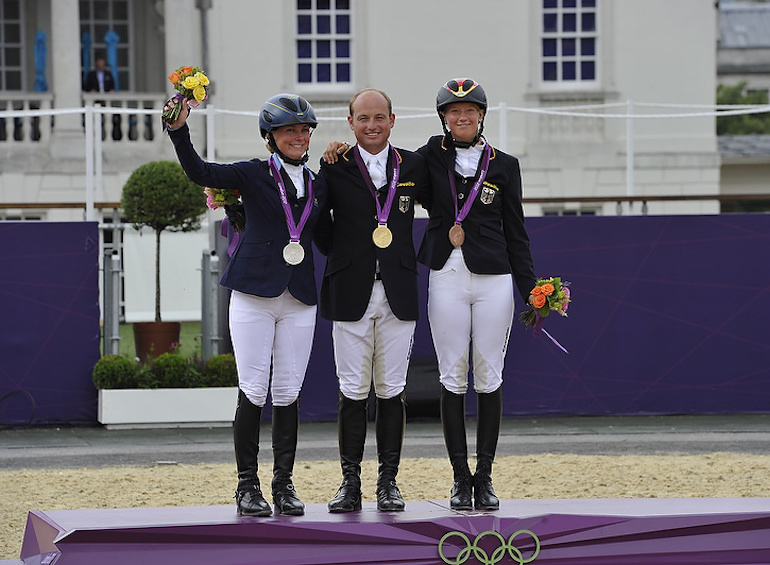
Individual medallists in the eventing

Finally, horse riding highlights the importance of understanding the sensory experience  of the human body in healing, as shown in the study by Lee Davis (2015) on the horse therapy among women equestrians in the US. Her article involves informants’ commentaries on their feelings while riding, which prove a great healing power of human-animal encounters. The riding is shown as a transformative experience and a kind of mutual being between the rider and his horse; a corporeal synchrony and extra-sensory experience where moving together gives a feeling of oneness. The riders could not exactly express their physical experience in words, but associated it with harmony, freedom and pleasure (ibid.). As an equestrian myself, I see how this activity has a big influence on my mental and physical state and enhances my feeling of well-being. I find all of my senses engaged during the encounter with my horse and every time his smell, touch and look have a calming quality and when galloping through an open space, I feel light and without any boundaries. In the hippo-therapy, the horse muscles are used to stimulate the muscle control and coordination of the patient, which highly involves the sense of touch. Lee Davis finds that the horse’s balance and movement produce a relaxing and trance-like state in the rider and greatly reduce the stress (ibid.). The size and power of the horse are also believed to have a stimulating effect on the human nervous-system.

To summarize, horse riding is a unique sport and hence creates a unique relation with the human, but also non-human body. The presence of the latter enables a subversion of dominant gender practices, particularly at the localized (private) level, and has been proven to have positive effects on mental and physical well-being. 

References:

  • Farnell, B. (1999). Moving Bodies, Acting Selves. Body Movement Practice. Annual Review Anthropology, Vol. 28, pp. 341-373. 
  • Lee Davis, D. et al. (2015). My Horse Is My Therapist: The Medicalization of Pleasure among Women Equestrians. Medical Anthropology Quarterly, Vol. 29 (3), pp. 298-315.
  • Merleau-Ponty, M. (1962). Phenomenology of Perception. C. Smith (translator). Routledge & Kegan Paul.

Deep in the water

When you enter the water, your heart starts pounding to pump blood to your muscles which contract, and your lungs tighten up and go into aerobic respiration and respond with oxygen (MySwimPro 2016). After a while, you’ve moved beyond that initial shock (and temperature change) and floated into a world where swimming is almost as comfortable as walking. Our brains love swimming because the extra blood and oxygen make us more focused, alert and awake (ibid.). It has been proven very beneficial for health and each style engages different parts of our body. 

Water is almost 800x more dense than air, and according to the Newton’s law of inertia, a body in motion stays in motion! But what’s actually happening inside your body as we swim?

Thus, we can say that swimming is good for everyone. But what about professional swimming. Is everyone made for that? In the last post, I was talking about the body normativity – how a human body that is „different” can be scrutinized in professional sports. However, a body deformity can also bring a great advantage.  

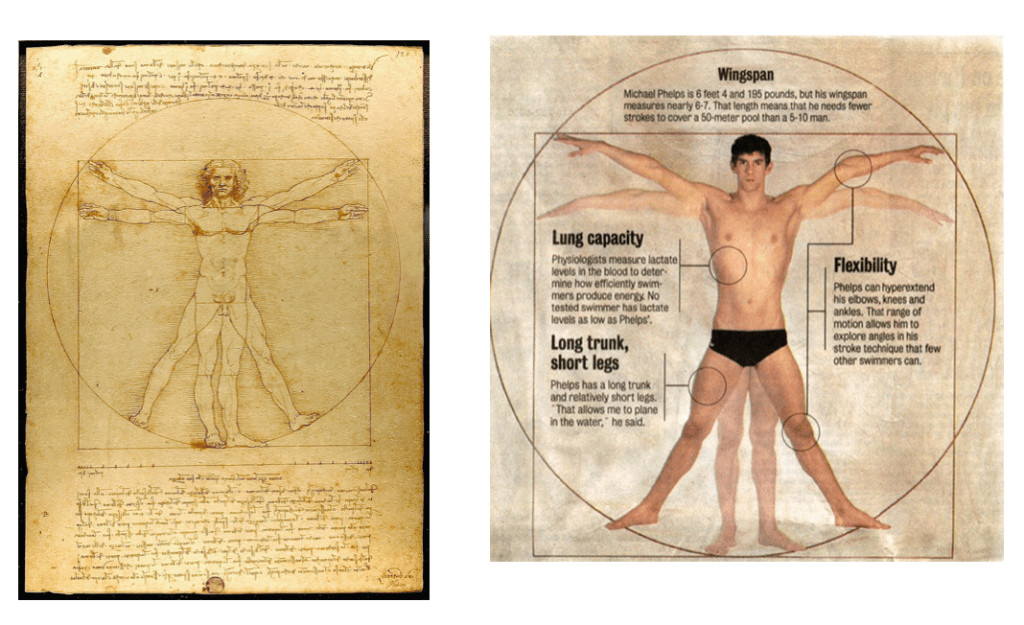
Michael Phelps (on the right) is nothing like the perfect Vitruvian Man envisioned by Leonardo da Vinci (on the left). This American former competitive swimmer is the most successful and most decorated Olympian of all time, with a total of 28 medals. Some of his unusual physical attributes make him particularly apt for swimming: his long, thin torso offers drag; his arms span 6 feet 7 inches (201 cm) – disproportionate to his height of 6 feet 4 inches (193 cm) – and act as long, propulsive paddles; his relatively short legs lower drag, and perhaps add the speed enhancement; his size-14 feet provide the effect of flippers; and his hypermobile ankles can extend beyond the pointe of a ballet dancer, enabling him to whip his feet as if they were fins for maximum thrust through the water. 

Surely, his body has changed over the years of exercise and in general, practicing sports greatly changes our body silhouette. However, like Phelps, some people are born physically predisposed for certain disciplines, while others need to work hard to achieve it. 

Talking about hard work, we can assume that Phelps’ trainings are not always light and easy and they do not only include swimming itself. Like with all top athletes, practice often includes pain, as I mentioned in the post on dance. As the body is our general medium for having a world (Merleau-Ponty 1962), chronic pain places the physical body in focus and puts the self in the shadow, reinforcing the Cartesian body/mind dualism. A career in sports demands sacrifice and pain disrupts other physical sensations. However, the positive pain in sports is certainly grounded in the drive for success.

The symbiotic relationship between sport and pain has allowed athletes who are able to control their pain through different techniques of the body (like diverting attention) to be more successful than those who cannot cope with pain (Deroche et al. 2011), again showing the superiority of mind over body, as the former can control the latter. From a Maussian perspective, an athlete comes to accept the body in pain as his own as it becomes a part habitus (Mauss 1935). As a famous slogan says – no pain, no gain. We are addicted to our own bodies and to the endorphins it produces during the physical movement. 

References:

  • Deroche, T. et al. (2011). Athletes’ inclination to play through pain: a coping perspective, Anxiety, Stress & Coping, Vol. 24 (5), pp. 579-587. 
  • Mauss, M. (1935). Chapter 1: the notion of techniques of the body. In: Techniques of the Body, pp. 70-88
  • Merleau-Ponty, M. (1962). Phenomenology of Perception. C. Smith (translator). Routledge & Kegan Paul.
  • MySwimPro. (2016). What happens to your body when you swim. [online]. Available at: https://myswimpro.com/blog/2016/05/24/what-happens-to-your-body-when-you-swim/  [Accessed 2 March 2020]. 

Run, Forrest, run!

Znalezione obrazy dla zapytania: run forrest run gif

Humans run almost every day, even without noticing – trying to catch a bus, crossing the street on the red light, or just when we realise we are late. When I think about running as an actual sport, I notice two themes that we cover in this course – the body and gender (and race) and destabilising normativity.

Debates on the biological sex vs social gender have been long present in anthropology. The works of scholars such as Judith Butler critique the idea of definitive gender and show that this body category should be constantly reworked in contemporary cultural spaces. In running, as an Olympic sport, this category is still very fixed. There is a clear distinction between men and women, which separates the two sexes into different competitions. Nevertheless, the famous case of the South African Olympic runner Caster Semenya also urges us to rethink how we actually define male and female. After her uncanny win at the World Championships in Berlin in 2009, questions were raised about her sex and possible drug use. The investigation revealed that she was born with XY chromosomes. Her hermaphroditism and high level of testosterone (3x the female norm) have excluded her from the competition until she decided to undergo a hormonal treatment to lower those levels and came back to the game.

“I am Mokgadi Caster Semenya. I am a woman and I am fast.”

Firstly, Semenya’s story calls the nature vs nurture debate. Epstein (2013) distinguishes between hardware (nature) and software (nurture), claiming that in elite athletes, one is useless without the other. He also examines race and gender. On the latter, he asks: „If only accumulated hours of practice matter, then why do we separate men and women in athletic competition?” (ibid.). Secondly, her story is about the constant efforts by sports governing bodies to create gender divisions that are fair to all athletes. But it’s also about what happens when an athlete, especially a black athlete, doesn’t „fit” into general ideas about womanhood. Her case shows how when people challenge perceived norms about masculinity and femininity, their bodies can become fodder for public discussion, often against their will. 

Bale & Sang (1996) quote John Hoberman: „The romanticizing of an African champion has served to link exotic physiological states with the racial alien and his alleged biological advantages”. Was is it also the case with Caster Semenya? Africa is often viewed as an emerging continental giant on the modern sporting stage. The Kenyan running itself has become and imaginative world in the mental map of the Western sports fan and general public. Nevertheless, their success is often explained in stereotypical and racist terms (ibid.)  

Thus, we can say that a white male is „the norm”. But isn’t it problematic? 

Yet another norm that is problematic is body’s ability. In most Western societies, medical sciences have usually defined disabled bodies as „broken”, „impaired” or „deficient”. Inevitably, this thinking makes the physical capabilities and limits of the human body intertwined in our social life by creating the binary approach and labelling people as „able” or „disabled”. 

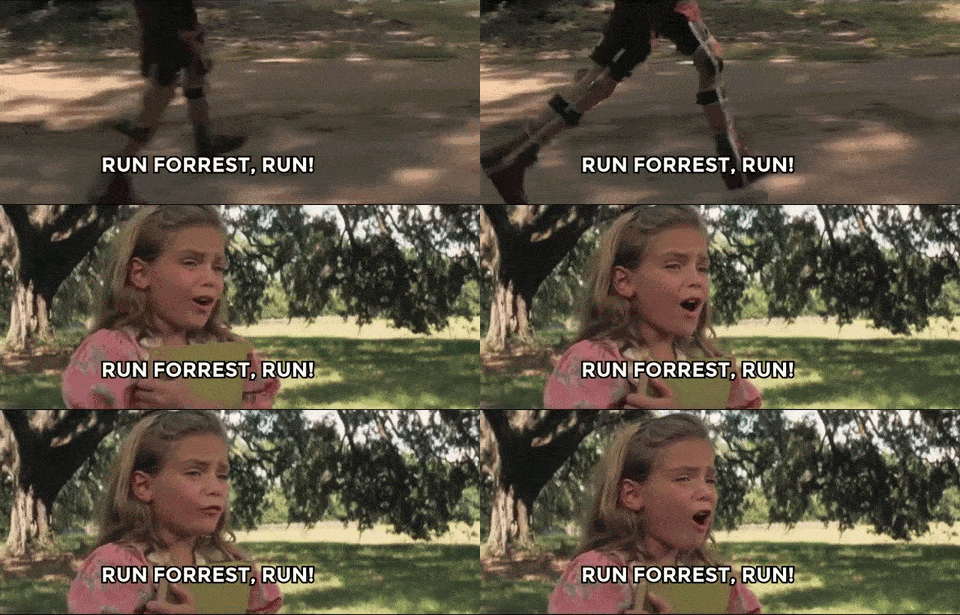
Oscar Pistorius is another professional sprinter from South Africa, with both feet amputated. After becoming a Paralympic champion, he attempted to enter non-disabled international competitions, against constant objections by the International Association of Athletics Federations (IAAF), who claimed that his artificial limbs gave an unfair advantage. Pistorius eventually won this legal dispute and at the 2011 World Championships, he became the first amputee to win a non-disabled world medal. 

Again, this shows how a human body that is not „normal” is scrutinised in professional sports. 

Looking at the cases of these athletes through the lens of Scheper-Hughes’ and Lock’s (1987) analysis of individual body,  social body and body politic, it may be that they do feel normal in terms of „phenomenally experienced body-self”, but in terms of representational uses of the body as a natural symbol to think about relations between nature, culture and society (as Mary Douglas suggested), the body in health offers a model of harmony, whereas a body in sickness – of disharmony. Thirdly, a body can be an artefact of social and political control à la Foucault. Apart from controlling the bodies in times of crises, societies constantly reproduce and socialise the types of bodies they need. In our increasingly „healthist” and body-conscious culture, the politically correct body is the strong, lean and physically „fit” form, through which the cultural values of autonomy, toughness, youth, and self-control are realised (ibid.).

Therefore, we might say that Olympics is an institution of power, which creates models of gender normativity and dictates the performance of our bodies.

References:

  • Bale, J. and Sang, J. (1996). Kenyan Running: Movement Culture, Geography, and Global Change. London: Frank Cass & Company. 
  • Epstein, D. (2013). The Sports Gene. Talent, Practice, and the Truth about success.  London: Yellow Jersey Press, Random House. 
  • Scheper‐Hughes, N. and Lock, M. M. (1987). The mindful body: A prolegomenon to future work in medical anthropology. Medical anthropology quarterly, Vol. 1 (1), pp. 6-41.

EveryBODY dance now

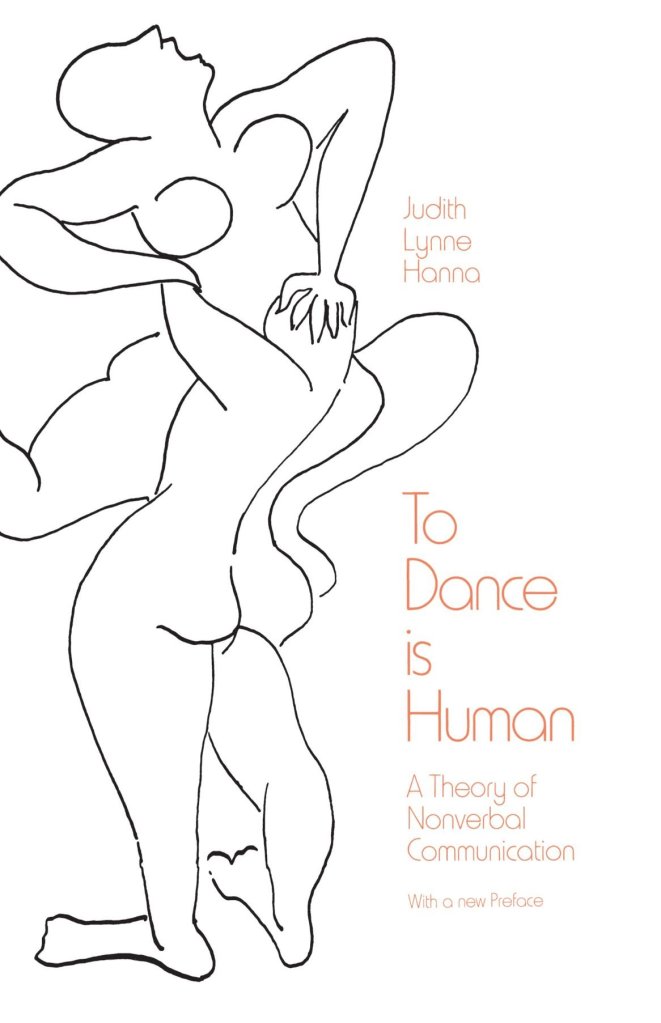
Although, out of the four disciplines that I am going to discuss, dance is the one that I have the least experience with, I think it is intrinsically linked with the human body and its movement, and that „To Dance is Human”, as Judith Hanna (1987) said.  

According to Farnell (1999), there has been a paradigmatic shift in anthropological studies of the human movement, which she defines as a “dynamically embodied action in semantically rich spaces”, or in other words, a “talk from the body”, which complements the earlier talks “about the body” (as a cultural object) and “of the body” (as a phenomenological realm of subjective experience). Indeed, dance is human because it is embodied, it is innate. It is our Maussian (1979) “bodily technique” (the ways in which from society to society men know how to use their bodies), or our Bourdieusian “habitus”, which has a meaning because of the specific context and social cohesion. 

Dance has been long devalued, like everything that referred to the meaningless body and not to the conscious mind. Although the body is more and more often portrayed as a socio-cultural entity rather than a purely biological object, it still remains separate from the mind (Farnell 1999), reinforcing the Cartesian dualism. Yet, it is the most natural and unspoiled form of the non-verbal communication. Blacking (1983) highlights the evolutionary importance of dance as a mode of communication, implied by the fact that it has not been superseded by the verbal language. In spite of the latter being generally more efficient, “the universality and survival of dance suggest that it cannot be abandoned without danger to human species” (ibid.: 89). The problem of relating movement to meaning has encouraged the usage of linguistic analogies by many scholars and making distinctions between the Saussurian langue and parole, or the code and the message. 

Dance is ultimately about action and conscious human intentions, as moving and giving it meaning are at the core of the dance experience. The important thing to remember is that this meaning can only be understood in a specific context of use and the conceptual worlds of its users. Hence, this requires that dance be studied cross-culturally through the everyday languages of different cultures.

The variety of dances can be considered a great human achievement (ibid.). For example, in the South African Venda society, the Domba dance represents a symbolic rebirth of the community and it produces a trance-like state in the performers. 

Hanna (1987) shows how the concept of dance, not necessarily a particular dancer’s or group’s definition, opens a cross-cultural discussion, particularly important in our multicultural world. Describing the physical actions of dance, like transcribing speech, is a first step in studying dance, and making sense of these movements (like the literary analysis) is the next.

Although dance is also closely linked with music, in one of the lectures we have seen a video of synchronic dance from the documentary “Samsara”, which showed the great power of human cooperation in performance and how, interestingly, those who are deaf can also perform this activity. Thus, do we really need music to dance?

Blacking (1983) argues that dance is similar to music, as it is a social fact born out of sociobiology, embedded in human behaviour (not invented), but still, music and dance have their own (socio-cultural) terms. Dance is also a social institution, as it is a way to express the feelings and “no matter how individual the inner world of a dancer may be, the feelings are culturally encoded as they are brought to action as dance” (ibid.: 95). This also implies that dance produces affect, which is emotion and the body movement and it is a deeply embodied and phenomenological experience in Marleau-Ponty’s terms (which is the individual point of view of the person experiencing the phenomenon).

Phenomenology is thus key to link motion and emotion. But emotions can also be hidden or enacted, as dance is a performance, which can even cause pain and push our body to its limits, like in the movie “Black Swan”. And although pain is acknowledged commonly, it is experienced individually and “intrinsically inexpressible” (Scarry 1987).

Yet still. EveryBODY dances.

References:

  • Blacking, J. (1983). Movement and Meaning: Dance in Social Anthropological Perspective. Dance Research: The Journal of the Society for Dance Research, Vol. 1 (1), pp. 89-99.
  • Farnell, B. (1999). Moving Bodies, Acting Selves. Annual Review of Anthropology, Vol. 28, pp. 341-373. 
  • Hanna, J. L. (1987). To Dance is Human: A Theory of Nonverbal Communication. University of Chicago Press. 
  • Mauss, M. (1979). Body techniques. From Mauss, Marcel, Sociology and psychology: essays, pp. 97-123, London: Routledge and Kegan Paul.
  • Scarry, E. (1987). Introduction of The Body in Pain, The Making and Unmaking of the World. Oxford University Press, pp. 3-23.